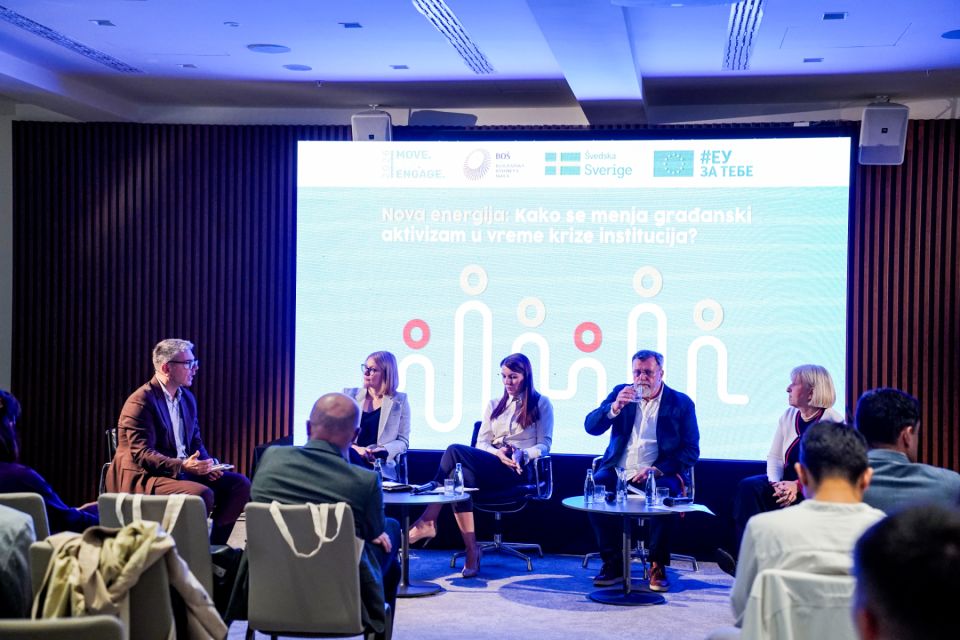
“There has been an unprecedented rise in civic activism in Serbia, and universities are the most popular institutions. It is now important to translate this activism into tangible change and harness it to democratise institutions,” said Professor Slobodan Marković, PhD, President of the Belgrade Open School Steering Committee, at the opening of the Move.Link.Engage. conference, “New Energy: How Is Civic Activism Changing Amid the Crisis of Institutions?”.
The opening remarks were delivered by Charlotte Sammelin, Ambassador of the Kingdom of Sweden to the Republic of Serbia, Julian Vassallo, Deputy Head of the Delegation of the European Union to the Republic of Serbia and Vladimir M. Pavlović, Programme Director at BOS.
The panel entitled “Increased Civic Activism and Closed Institutions: New Roles for Civil Society, Academia and the Media” featured Professor Mirjana Nikolić, PhD, Rector of the University of Arts in Belgrade; Veran Matić, Chair of the Board of Directors of the Association of Independent Electronic Media (ANEM); Bojana Džulović, Manager of the EU Resource Centre for Civil Society in Serbia; and Dragana Aleksić, former Deputy Director of the Republic Secretariat for Public Policy.
Speaking during the panel, Džulović highlighted the growing number of informal groups: “These are essentially neighbourhood groups made up of people from the same area who come together to address a local problem. This type of activism is widespread throughout the country.”
The second day of the conference focused on the European integration prospects of the Western Balkan countries.
The conference also welcomed Predrag Zenović, Montenegro’s Chief Negotiator for EU Accession Negotiations. Zenović said he expected Montenegro to close all remaining negotiating chapters by the end of the year. He added that civil society had played an almost pivotal role in Montenegro’s Europeanisation process and that, in certain situations, civil society actors had demonstrated a better understanding of the key steps required to advance this process.
The conference also explored civic initiatives across the region. Among the guests was Zydjon Vorpsi, a representative of the Flamingo Movement and the Protection and Preservation of Natural Environment in Albania (PPNEA).
As is tradition, the conference also featured the presentation of the Change Makers Awards, as well as the awarding of diplomas to the 33rd generation of students of the Future Studies programme at the Belgrade Open School.